How Block Puzzle Games Are Designed: The Block Blast Playbook
PGP Studio Team · July 17, 2026 · 9 min read
Block Blast! was 2026's most-downloaded mobile game, almost entirely on ad revenue, not IAP. A genre design breakdown worth studying.

Block Blast! was the single most-downloaded mobile game worldwide across January to February 2026, pulling 28.1M downloads in January alone and still adding 23.8M more in April. As of May 2026 it was tracking 208.7 million monthly active users and 35.5 million daily active users, with an average session length of 12.06 minutes and 2.71 sessions per day. Numbers at that scale are worth studying carefully, not just admiring, because they tell you exactly what a genre design can support when it's stripped down to its most essential form, with almost nothing left in the design that isn't earning its place in the core loop.
Its retention curve is a textbook casual-puzzle decay pattern: D1 26.1%, D7 4.1%, D30 1.1%, D90 0.4%, D365 0.1%, which reads as alarming out of context but is normal, even strong, at this install volume for the genre. A steep early drop-off paired with a small, extremely loyal long-tail is the expected shape for a game this simple to pick up and this easy to set aside; the design goal isn't flattening that curve, it's making sure the huge top-of-funnel volume monetizes well during the sessions it does get, before the natural decay sets in for the vast majority of that initial cohort.
What's more interesting is the revenue mix: almost entirely ad-driven rather than IAP-driven, with estimated daily ad revenue around $584,000 against lifetime IAP revenue of only around $66,000. Design-wise, there's no battle pass and no aggressive monetized store, just clarity-first block-placement rules borrowed from classic line-clearing mechanics, interstitials between levels, and a rewarded-ad safety valve near failure states.
The Core Loop Is Deliberately Under-Engineered
The defining design choice in this genre isn't any single clever mechanic, it's the absence of unnecessary ones. A block-drop-and-clear loop with a fixed grid, a small set of piece shapes, and a single scoring mechanism is legible within seconds of the first session, with zero tutorial friction beyond maybe one instructional overlay. Every additional system a designer is tempted to add (combo multipliers, special block types, power-ups) has to justify its complexity cost against that baseline legibility, and most genre entries that add too much too early lose the exact quality that made the format work in the first place.
This is the same principle we apply across our own block puzzle catalog: the core placement-and-clear loop has to be understandable from the very first block a new player drags, with any additional depth (mode variety, difficulty curves, daily challenges) layered on top of that unchanged foundation rather than folded into it. A player who has to learn the core rules and a secondary system simultaneously in their first session is a player who is meaningfully more likely to bounce before either system has had a chance to land.
Failure States Are Where the Genre's Monetization Actually Lives
A rewarded-ad safety valve near failure states does more design work in this genre than almost any other single mechanic, because a near-loss on a mostly-clear grid is the single most legible, most emotionally charged moment in the entire session. The player can see exactly how close they were, which makes the voluntary trade (watch a short ad, get one more placement) feel proportionate rather than exploitative, and that perceived fairness is a large part of why this pattern converts as well as it does across the genre broadly, not just in this one title.
The interstitial placement between levels works for the same underlying reason interstitials work anywhere: it lands at a natural pause the player was already taking, not mid-placement. Genre design and monetization design aren't separate concerns here, they're the same decision viewed from two angles: a clean, honest break point in the core loop is both good UX and a legitimate ad placement, and a genre built around frequent, well-defined round-ends (as line-clearing puzzle games structurally are) has more of these natural break points available than almost any other mobile genre.
Piece Set Design Is the Genre's Real Skill Ceiling
The specific set of block shapes a designer chooses, and the probability distribution used to serve them to the player, is the actual design skill this genre rewards, even though it's mostly invisible to players. Too generous a piece distribution and the game never creates tension; too punishing and players feel cheated rather than challenged. Tuning this distribution against actual player board-state data, not just designer intuition, is where the difference between a forgettable genre entry and a chart-topping one actually gets made.
This tuning work never really finishes. Player skill distributions shift as an install base matures, and a piece distribution tuned correctly for a fresh cohort of new players can feel too easy for a veteran player base six months in. Treating piece-set tuning as a live, ongoing balance pass rather than a value locked at launch is standard practice across the serious entries in this genre, our own included.
Why a Small, Focused Ruleset Scales Further Than a Feature-Heavy One
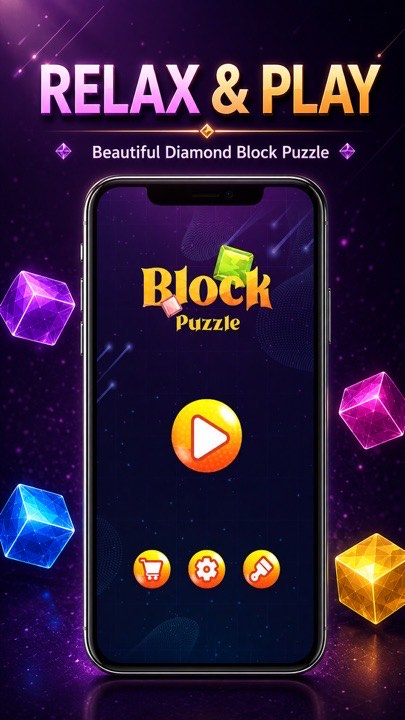
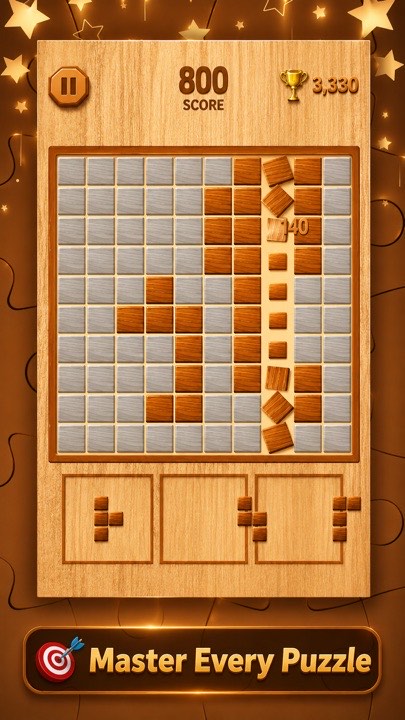
It's a genre playbook worth studying directly against our own Diamond Block Puzzle Star Game and Wood Block Puzzle, same core mechanic family, and proof that a small, focused ruleset scales further than a feature-heavy one. The counterintuitive lesson for teams coming from other genres is that adding features is usually the wrong instinct when a casual puzzle title underperforms; the more common fix is removing friction from the existing loop rather than adding new systems on top of it.
This has direct implications for how we scope new titles in this genre. Every new mechanic proposed for a block puzzle prototype has to clear a specific bar: does it make the core loop meaningfully more replayable without adding a comprehension cost in the first session. Mechanics that fail that test get cut regardless of how interesting they are in isolation, because the genre's ceiling is set by how many players make it through session one with the loop intact, not by how deep the mechanic set is for the small fraction of players who stick around long enough to explore it.
Feedback and Game Feel Carry More Weight Than the Rules Themselves
Given how mechanically simple this genre's rules are, the moment-to-moment feel of placing and clearing blocks does an outsized share of the work in making a session satisfying. Clear audio and visual feedback on a successful line clear (a distinct sound, a brief flash or particle burst, a satisfying score pop-up) is not decoration, it's the primary reward signal the player receives dozens of times per session, far more often than any menu-level progression system fires. Genre entries that under-invest here, treating feedback as an afterthought layered on at the end of production, consistently underperform titles with equivalent mechanics but more attention paid to how a clear actually feels.
The tuning consideration that's easy to get wrong is timing: feedback that's too slow to trigger after the action breaks the sense of direct causation between the player's placement and the reward, while feedback that's too fast or too subtle fails to register as a distinct, satisfying event at all. We iterate on clear-feedback timing using the same frame-accurate profiling tools discussed in our Unity performance coverage, since a delay caused by dropped frames during a clear (the exact moment the game most needs to feel responsive) undermines feel in a way that's easy to miss without deliberately testing for it on real hardware.
Progression Systems Should Support the Loop, Not Replace It
Daily challenges, mode variety, and light meta-progression (unlockable themes, milestone rewards) all serve a specific purpose in this genre: giving a returning player a reason to open the app today specifically, on top of a core loop that doesn't itself change. The mistake to avoid is treating these systems as the primary retention driver and neglecting the core loop's own replayability, when in a well-designed casual puzzle title the relationship runs the other way: progression systems only work because the core loop underneath them is replayable enough to sustain repeat sessions in the first place.
Our own approach across Classic, Time, Blast, and Advanced modes in Diamond Block Puzzle Star Game follows this ordering deliberately: each mode is a distinct ruleset variation built on the same underlying placement mechanic, giving genuine variety without asking a returning player to learn a new core interaction each time. That's a meaningfully different design decision than adding a currency-and-unlock meta-layer on top of a single unchanging mode, and it's the one we've found holds up better for a genre where the core mechanic itself is the primary draw, not a wrapper around it.
The Difficulty Curve Is What Actually Produces That Retention Cliff
The D1 26.1%, D7 4.1%, D30 1.1% curve cited at the top of this piece isn't an accident of the genre, it's a direct, legible signature of how the difficulty ramp is tuned, and reading it that way is more useful to a designer than treating it as a fixed genre ceiling to accept. The steep D1-to-D7 drop specifically tends to trace back to one of two tuning mistakes: a difficulty ramp that stays too easy for too long, so a meaningful share of players get bored before the game has shown them anything worth returning for, or one that ramps too aggressively too early, so a newer player hits a genuine skill wall before the core loop has had a chance to become habitual. Both failure modes produce the same visible symptom, an early cliff in the retention curve, which is exactly why raw retention numbers alone don't tell a designer which problem they actually have.
The diagnostic we actually run to tell the two apart: segment session length and failure-state timing specifically for the cohort of players who churn between day 1 and day 7, separately from the cohort that survives past day 7. A boredom-driven churn cohort shows long sessions with few failure states right before dropping off, the game simply stopped giving them a reason to return. A difficulty-wall churn cohort shows short, frustrated sessions with a spike in failure-state frequency right before the drop, the game asked for more skill than that specific player had built up yet. The fix for each is close to the opposite of the other, easing the mid-game ramp for a difficulty-wall problem versus introducing a new mechanic or mode earlier for a boredom problem, which is exactly why treating 'improve retention' as a single undifferentiated goal produces so many wasted tuning passes across the industry.
Running Multiple Titles in One Genre Changes How You Design Each One
Diamond Block Puzzle Star Game, Wood Block Puzzle, and Move The Block: Brain Puzzle all live in the same broad genre in our own catalog, and building three titles in the same design space at once is a meaningfully different exercise than building one title in isolation, in ways that aren't obvious until you've actually done it. The first real difference is deliberate mechanical differentiation: three titles built around an identical core loop cannibalize each other's audience and give a player no real reason to have more than one installed, so we treat each title's specific twist (jewel-themed scoring and combo chains, a wood-block aesthetic with its own piece set, a sliding-block mechanic that's mechanically distinct from a drop-and-clear loop) as a hard requirement from the earliest design pass, not a cosmetic skin applied after the fact.
The second, less obvious benefit is cross-portfolio signal: a difficulty-tuning or monetization insight validated on one title in the catalog is a hypothesis worth testing on the others, not a guaranteed transfer, since audience composition and specific mechanics still differ enough that a change proven on one title needs its own validation pass elsewhere, but starting from a validated hypothesis rather than a blind guess meaningfully speeds up the tuning cycle across the whole portfolio. Cross-promotion between titles in the same genre is the third, most direct benefit, and it's one of the few genuinely free acquisition channels available to a small studio: a player who churns from one block puzzle title but is shown a genuinely differentiated sibling title at the right moment is a meaningfully warmer prospect than a cold install from any paid channel, precisely because they've already demonstrated they like the genre.
What This Means for Anyone Building in This Genre
The lesson from Block Blast!'s numbers isn't 'copy this specific title,' it's that the ceiling for a disciplined, clarity-first execution of a well-worn mechanic is still enormous, even in a genre as saturated as block-clearing puzzles. Chasing novelty for its own sake is a weaker strategy than executing the fundamentals (legible core loop, honest monetization tied to genuine failure moments, disciplined piece-distribution tuning) more carefully than the competition. That's a less exciting story to tell than 'we invented a new mechanic,' but it's the one the retention and revenue data actually supports, in this title and across the genre generally.
For a studio deciding whether to enter this genre at all, the honest answer is that the mechanic itself is not a moat; dozens of near-identical block-clearing puzzle games exist on Google Play and the App Store right now, competing directly for the same discovery real estate, and mechanical novelty won't be what differentiates a new entry. What differentiates it is execution discipline on exactly the areas covered above: feedback quality on every clear, a piece distribution tuned against real player data rather than launch-day intuition, monetization placements that respect natural break points instead of interrupting the core loop, and a willingness to keep the core rules simple even as pressure builds internally to add features that make a pitch deck look more impressive. None of that is glamorous work, but it's the actual difference between a genre entry that disappears in a crowded store and one that finds a durable audience, and it's exactly why we keep returning to this same execution checklist across every new block puzzle prototype we scope, rather than starting each one from a blank slate in search of a new hook that the data above suggests players were never really asking for in the first place. We return to this specific genre playbook every time we scope a new puzzle prototype, treating it less as a one-time analysis of a single chart-topping title and more as a standing checklist against which every new concept in this genre gets measured before it earns a place on our own roadmap.
If you're building something similar, two things worth reading next: our Mobile Game Onboarding FTUE guide, since the first few minutes matter as much as the mechanics do, and our Best Offline Puzzle Games roundup on where and how players actually find a game like this. This exact design discipline shapes every title in our published catalog.
Need design help for your next title?
This exact design discipline is what shapes every game in our published catalog.
Play Our GamesGet Unity dev tips in your inbox
Practical guides on Unity, ASO, XR, and mobile monetization from the PGP Studio team. No spam, unsubscribe anytime.
Browse all articles